

Articles

- Details
- Category: Practice
"Knowing that something cannot be done is not enough. Knowing whether it is physically impossible or normatively prohibited determines who has the authority to change it."
A blueprint is not a building. A legal requirement is not a physical constraint. What a regulation permits is not the same as what physics allows.
This also seems obvious, yet the distinctions collapse in practice. When a project team argues about what is "necessary," one person may mean logically unavoidable, another may mean contractually required, a third may mean technically mandatory given the chosen architecture. None of them is wrong about their own meaning, but they are reasoning from different modality categories, and without language for the distinction, the conversation has no resolution.
- Details
- Category: Practice
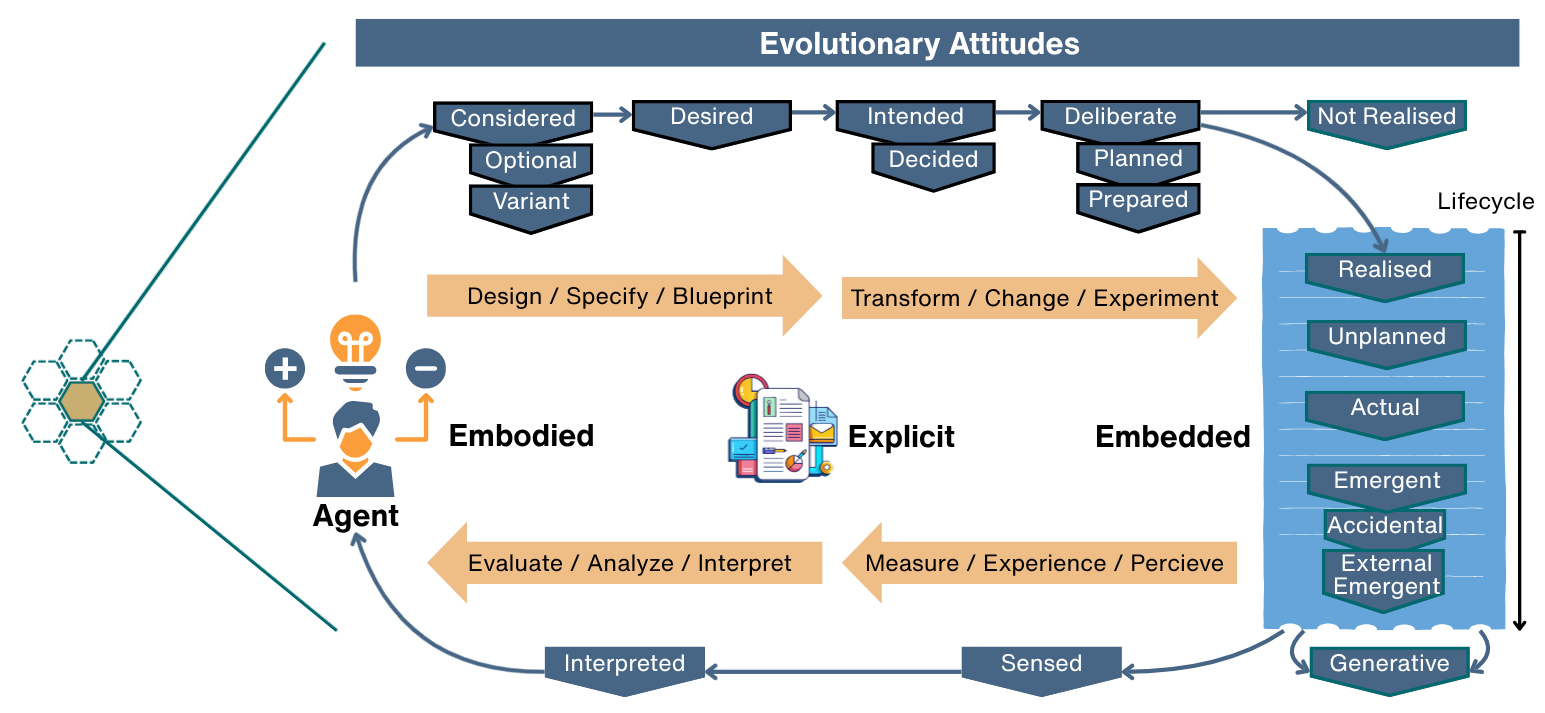
"The argument is rarely about the work itself. It is about the stances people hold toward it, held without anyone recognising the distinction."
Three people walk out of the same strategy review. One believes the plan is feasible. One thinks it will need significant revision before it becomes useful. One is certain it will be ignored the moment the meeting ends. None of them is wrong. They are holding different attitudes toward the same object.
This scenario plays out in every organisation, every week, across every discipline that touches strategy, design, architecture, and Interweave. The confusion it generates is not primarily about the work itself. It is about the stances people hold toward it, what they believe, what they intend, what they are willing to act on.

- Details
- Category: Practice
When we think of strategy, architecture, or design, we often picture tangible outputs: the detailed strategic plan in a binder, the architectural blueprint, or the final design model. However, these documents represent only a fraction of the total knowledge. The real substance of any strategic or design initiative exists in multiple forms, often unseen and unapparent.
Consider what happens in practice: Those who participate in strategy sessions or design reviews know far more than what appears in the final documents. They understand the reasoning behind decisions, the options explored and rejected, the trade-offs debated, and the compromises reached. Similarly, a building may start according to specifications, but over time it evolves—adapted by its users, shaped by wear, and modified to meet changing needs. Strategic plans translate into patterns of decisions and behaviours, some deliberate, others emerging from organisational culture and unforeseen circumstances.
- Details
- Category: Standalone
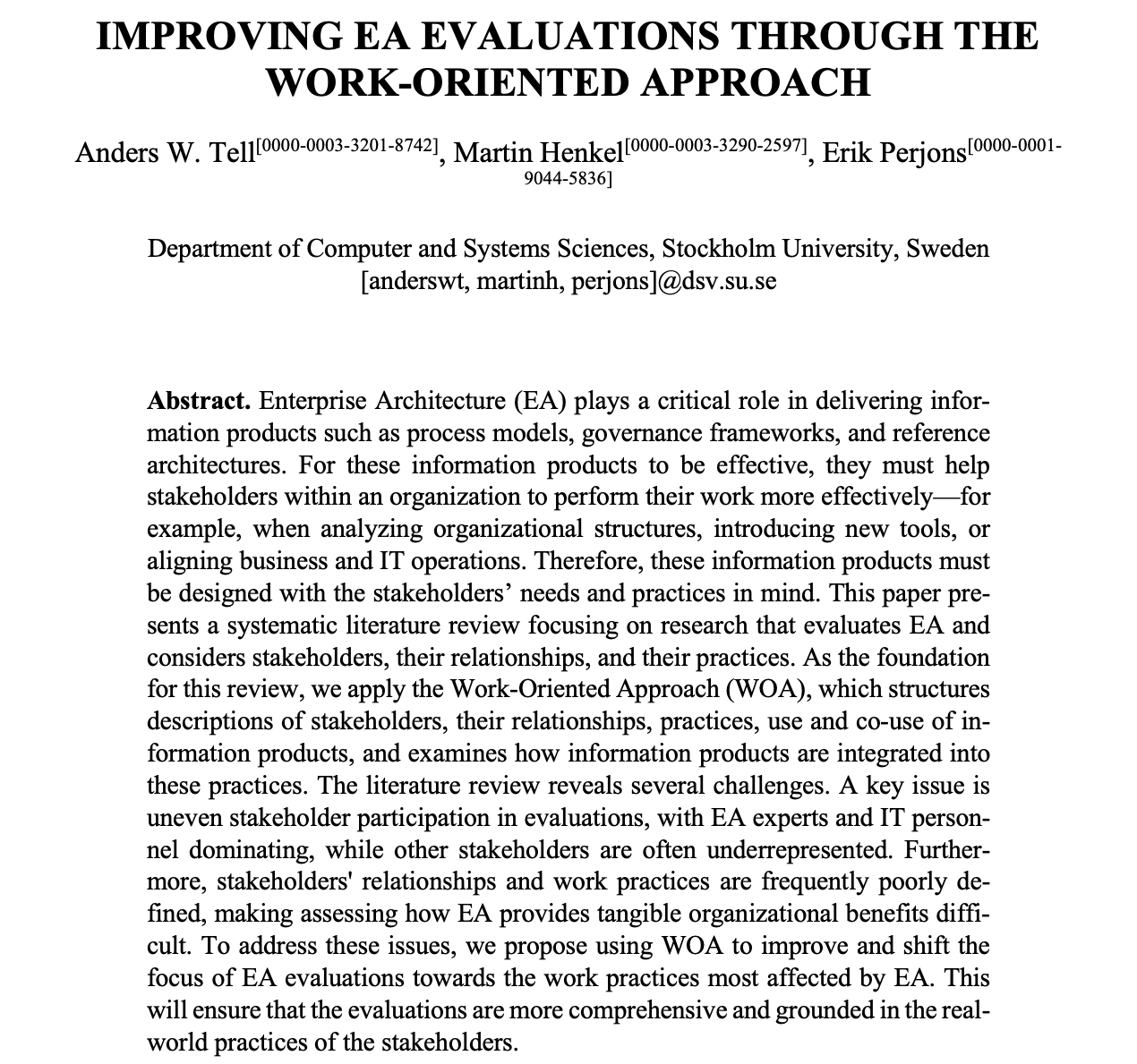
What a systematic literature review reveals about how EA is assessed — and what is missing
A peer-reviewed paper co-authored with Martin Henkel and Erik Perjons of Stockholm University — "Improving EA Evaluations Through the Work-Oriented Approach" — has been published in Springer Nature's Communications in Computer and Information Science (CCIS) series.
The central finding is blunt: enterprise architecture research predominantly evaluates EA through the eyes of those who produce it. The stakeholders whose work EA is supposed to improve are largely absent from the evaluations that claim to assess whether it does.
Contact:
WorkEm Toolsmiths
info AT workem.com
+46 768 790730
+49 152 2241 0640
Locations:
Munich
Milano