1. Introduction
Alignment has become one of the most repeated words in Enterprise Architecture.
- Business alignment
- IT alignment
- Strategic alignment
- Capability alignment
- Portfolio alignment
- Operating model alignment
The assumption sits underneath modern architecture almost unnoticed:
If the enterprise is aligned, the enterprise will coordinate effectively.
But many organisations already know something is wrong with that assumption.
They have:
- governance,
- synchronised roadmaps,
- target architectures,
- target operating models,
- transformation offices,
- steering committees,
- integration programs.
Yet they still feel fragmented.
Different parts of the organisation still operate with different interpretations of reality. Decisions still collide across boundaries. Strategies still drift as they move through the organisation. People still spend large amounts of time re-establishing shared understanding before meaningful coordination can even begin.
The organisation is aligned.
But it is not coherent.
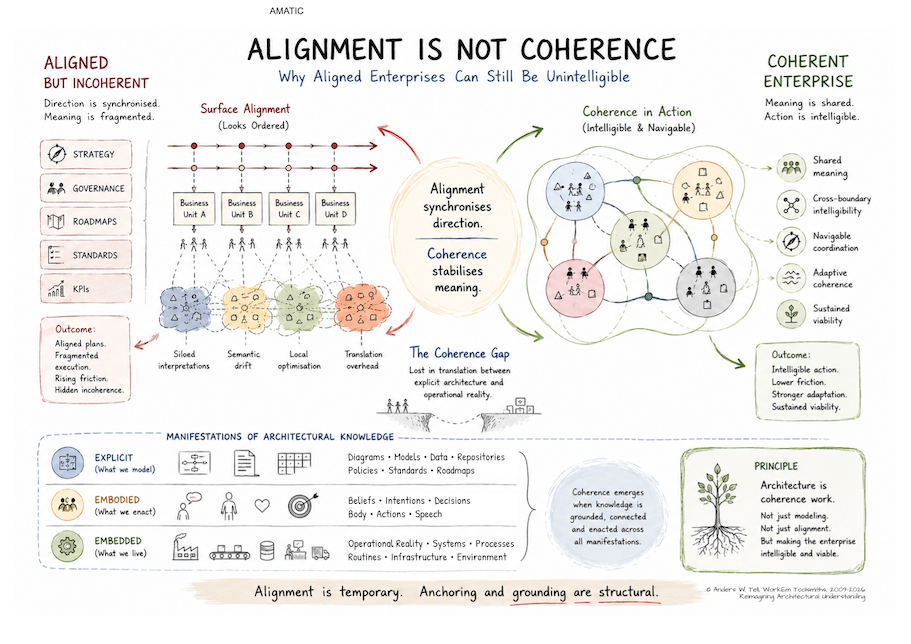
Alignment synchronises direction.
Coherence stabilises meaning.
That distinction matters more than Enterprise Architecture currently recognises.
2. Alignment Everywhere
Modern Enterprise Architecture discourse is saturated with alignment.
Architecture aligns business and IT.
Governance aligns execution with strategy.
Operating models align capabilities.
Transformation programs align stakeholders.
Alignment has gradually become treated as the organisational ideal itself.
The problem is that alignment primarily describes directional compatibility.
It describes whether entities move in approximately compatible directions.
It does not necessarily describe whether the enterprise remains intelligible, navigable, stable, or meaningfully coordinated across boundaries.
An enterprise can therefore become highly aligned while simultaneously becoming operationally fragmented.
This is one of the hidden problems inside modern architecture.
3. The Distinction
Interweaving treats these concepts as different categories of relational construct.
3.1 Alignment
Alignment is a relationship operator:
Alignment is a directional and intentional relationship operation that seeks compatibility or reduction of difference toward compatible objectives.
Alignment attempts to reduce divergence.
3.2 Cohesion
Cohesion is a relational condition:
Cohesion is the relational condition in which elements are held together through reinforcing affinity, attachment, compatibility, alignment, shared participation, or mutual connection.
Cohesion describes bonding.
3.3 Coherence
Coherence is an emergent systemic condition:
Coherence is the emergent systemic condition in which a manifestation sustains intelligibility, viable relational continuity, and meaningful integration through sufficient reinforcement and constraint satisfaction across interacting elements and relations.
Here, a manifestation refers to a form in which architectural knowledge exists: explicitly in artefacts and representations, embodied in agents and practices, or embedded in operational structures, routines, environments, and systems.
Manifestations, therefore, concern how architectural knowledge becomes:
- present,
- actionable,
- socially situated,
- operationally encounterable,
- and participatory within enterprise reality.
(See Beyond Blueprints - Manifestations for a fuller explanation.)
Coherence describes whether manifested architectural knowledge remains meaningfully understandable, navigable, and coordinatable within a selected scope and context.
These are not interchangeable ideas.
Alignment seeks directional compatibility.
Cohesion strengthens local bonding.
Coherence sustains viable systemic intelligibility.
They are different types of relational constructs and belong to different categories of relational analysis.
Treating an operator like alignment as if it were a systemic condition like coherence is not just a misuse of language.
It distorts what architecture measures and optimises.
Traditional Enterprise Architecture often treats them as if they were the same thing.
They are not.
4. The Hidden Problem
Consider a large bank attempting to create a "single customer view" across the enterprise.
The initiative appears highly aligned.
The executive committee agrees on the direction.
The architecture board approves the target architecture.
The transformation roadmap is synchronised.
The data governance initiative is aligned with the customer strategy.
The CRM modernisation program aligns with the integration roadmap.
The reporting structure aligns incentives around customer-centricity.
Everything appears coordinated.
Yet operationally, the enterprise remains fragmented.
Retail banking defines a customer differently from wealth management.
Risk systems maintain separate identity assumptions.
Regional systems apply incompatible regulatory interpretations.
Call-centre staff see different customer histories than relationship managers.
AI-assisted service systems produce different recommendations depending on which data boundary they cross.
The organisation continues to produce conflicting operational realities while formally claiming strategic alignment.
Architects in such organisations often find themselves in the same meeting week after week, translating between conflicting definitions of "customer" and reconciling divergent reports.
Alignment shows green.
Coherence shows up only as growing coordination overhead and erosion of trust in shared artefacts.
Meetings increasingly become exercises in translation.
Cross-functional work slows because teams must continuously re-establish what shared terms actually mean.
The architecture repository grows while situated understanding declines.
This is what aligned incoherence looks like:
- governance and roadmaps are synchronised,
- but shared intelligibility and navigable continuity have quietly broken.
The organisation is aligned.
But the enterprise is not coherent.
This is not unusual.
Many enterprises already operate this way.
They possess:
- synchronised governance without shared intelligibility,
- aligned roadmaps without grounded coordination,
- integrated systems without meaningful continuity across organisational boundaries.
Modern enterprises are increasingly full of:
- synchronised governance,
- aligned roadmaps,
- and integrated systems,
while still lacking:
- shared intelligibility,
- grounded coordination,
- and meaningful continuity.
Alignment created directional consistency.
It did not create coherence.
5. Why Alignment Is Structurally Limited
Alignment is useful.
But alignment primarily addresses direction.
It does not by itself produce:
- grounded meaning,
- participatory intelligibility,
- stable interpretation,
- coherent cross-boundary coordination,
- navigable continuity,
- or adaptive relational viability.
This becomes increasingly visible in large federated enterprises.
Different organisational units can remain strongly aligned to strategic goals while simultaneously developing incompatible local interpretations, practices, metrics, vocabularies, and operational assumptions.
In fact, local optimisation often increases fragmentation.
The stronger local alignment becomes inside isolated domains, the harder cross-boundary coordination sometimes becomes.
Highly cohesive silos can still produce systemic incoherence.
This is one reason architecture functions increasingly experience coordination overload.
The enterprise spends more and more time attempting to reconnect interpretations that drifted apart despite formally aligned governance structures.
Enterprise Architecture dashboards typically report:
- strategic alignment,
- application alignment,
- roadmap alignment,
- capability alignment,
- and governance alignment.
They rarely report:
- whether agents can still navigate the enterprise meaningfully,
- whether representations remain grounded in practice,
- whether operational behaviour still reinforces architectural intent,
- whether manifested architectural knowledge remains intelligible across contexts,
- or whether decisions retain continuity as they move across organisational boundaries.
This is the practical impact of the category mistake:
We optimise an operator because we can measure it, and then assume the systemic condition has improved.
The problem is not insufficient alignment.
The problem is treating alignment as if it were equivalent to coherence.
6. The Category Mistake
This is the deeper architectural mistake.
Alignment is an operator.
Coherence is a systemic condition.
They belong to different categories.
Alignment attempts to create compatibility between entities.
Coherence describes whether meaningful continuity actually emerges across interacting meanings, practices, representations, structures, and operational realities.
Architecture has been optimising an operator and calling it coherence.
This confusion runs deeply through modern Enterprise Architecture.
Architecture often measures:
- strategic alignment,
- application alignment,
- capability alignment,
- governance alignment,
- roadmap alignment,
- stakeholder alignment.
But much less attention is given to whether the enterprise itself remains intelligible across interacting boundaries.
Whether people can still navigate the organisation meaningfully.
Whether representations remain grounded in operational realities.
Whether embodied practices continue to reinforce explicit architectural intent.
Whether embedded operational structures sustain understandable continuity.
Whether coordination remains viable as complexity increases.
Alignment contributes to cohesion.
But alignment alone does not produce coherence.
Coherence emerges through ongoing interaction, interpretation, adaptation, participation, reinforcement, grounding, and constraint satisfaction.
It must continuously re-emerge.
7. Coherence as an Architectural Concern
This is why coherence is architectural.
Not merely managerial.
Architecture is not only concerned with directional synchronisation.
Architecture is concerned with whether enterprises remain navigable and understandable across boundaries.
Whether strategies maintain meaningful continuity as they move into operations.
Whether organisational representations remain intelligible across practices.
Whether systems, processes, goals, and human understanding continue to reinforce rather than fragment each other.
In Interweaving, coherence is not an abstract virtue.
It is the systemic condition that emerges when architectural knowledge remains sufficiently:
- grounded,
- intelligible,
- operationally encounterable,
- and meaningfully reinforced across enterprise reality.
Where anchoring and grounding are weak, alignment efforts tend to slide into incoherence even when governance appears mature.
Coherence is diagnostic.
Anchoring and grounding are stabilising disciplines.
Coherence is therefore not a cosmetic property layered on top of architecture.
It is one of the conditions that determines whether architecture remains useful at all.
An architecture that people can no longer meaningfully navigate eventually stops participating in coordination.
At that point, the architecture may still exist formally.
But operationally, it has already failed.
8. The Interweaving Reframing
Interweaving approaches architecture differently.
Interweaving treats coherence as an architectural concern rather than merely a managerial outcome.
It treats architectural work as participation in sustaining intelligibility and grounded coordination across boundaries.
This shifts the architectural focus.
From:
- alignment,
- governance,
- representation,
- and repository completeness.
Toward:
- intelligibility,
- participation,
- grounding,
- manifestation awareness,
- and coherence.
Interweaving, therefore, pays attention not only to what architecture says explicitly, but also to how architectural knowledge becomes:
- embodied in practices,
- embedded in operational realities,
- and enacted through participation and coordination.
Anchoring keeps architecture relevant to situated practice.
Grounding gives architectural entities meaningful reference points and dependency continuity.
Coherence is what those disciplines stabilise.
Alignment alone cannot produce it.
9. Practical Implications
The distinction becomes even more important in AI-shaped enterprises.
Organisations increasingly deploy multiple AI systems aligned to local objectives:
- sales AI optimised for conversion,
- logistics AI optimised for efficiency,
- finance AI optimised for margin,
- HR AI optimised for workforce metrics.
Each system may remain locally aligned to its KPI.
Yet collectively, the enterprise becomes harder to understand.
Customer promises diverge.
Operational tradeoffs become opaque.
Decision rationale fragments across systems.
Different parts of the organisation generate incompatible interpretations of the same reality.
In review meetings, leaders increasingly find they cannot explain why one AI system recommends one thing while another recommends the opposite, even though both systems remain aligned to their KPIs.
Decision rationale fragments into opaque model internals.
Local alignment begins generating systemic incoherence.
The stronger AI becomes, the more grounding enterprises require.
This is not primarily a governance problem.
It is a coherence problem.
And coherence problems increasingly appear first as:
- interpretive fragmentation,
- coordination overload,
- unstable meaning,
- conflicting operational realities,
- and erosion of enterprise intelligibility.
10. Closing
Modern enterprises do not merely suffer from insufficient alignment.
They increasingly suffer from fragmentation of meaning, interpretation, participation, and coordination across boundaries.
Architecture that treats alignment itself as success will often miss this until coordination has already begun to fail.
Enterprise Architecture has spent decades optimising alignment while often overlooking coherence itself.
But aligned organisations can still become unintelligible.
And unintelligible enterprises eventually lose their ability to coordinate.
Alignment synchronises direction.
Coherence stabilises meaning.
Alignment is temporary.
Anchoring and grounding are structural.
/Anders W. Tell
Reimagining Architectural Understanding