

Articles
- Details
- Category: Reimagine Architecture
Reimagine Architecture
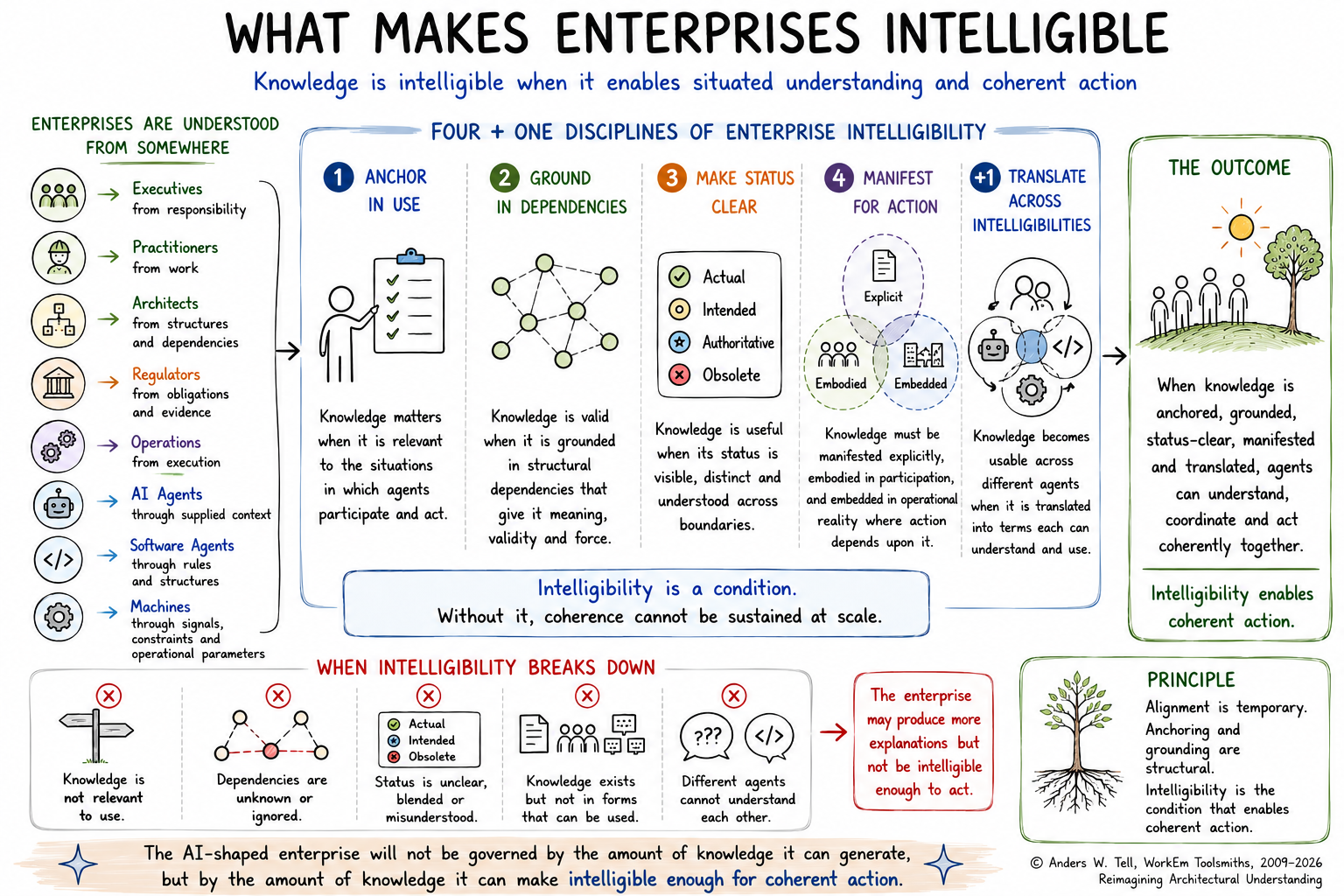
An enterprise becomes intelligible when knowledge is built so agents can use it for situated understanding and coherent action.
In Enterprise Intelligibility: When More Explanation Does Not Mean More Understanding, the diagnosis was established. Enterprises can become increasingly described while becoming increasingly difficult to understand. The question left open was not whether this happens. The question was what must be built if an enterprise is to become intelligible enough for action.
Alignment may point.
Coherence must hold.
Intelligibility enables agents to act.
This article is therefore not about diagnosis. It is about construction.
An enterprise becomes intelligible when knowledge is built so that agents can use it across boundaries for understanding, judgement, coordination, and action. Intelligibility does not appear automatically when information is collected, documented, modelled, governed, or generated. It emerges when knowledge becomes usable within the interweave of enterprise participation.
- Details
- Category: Reimagine Architecture
Reimagine Architecture
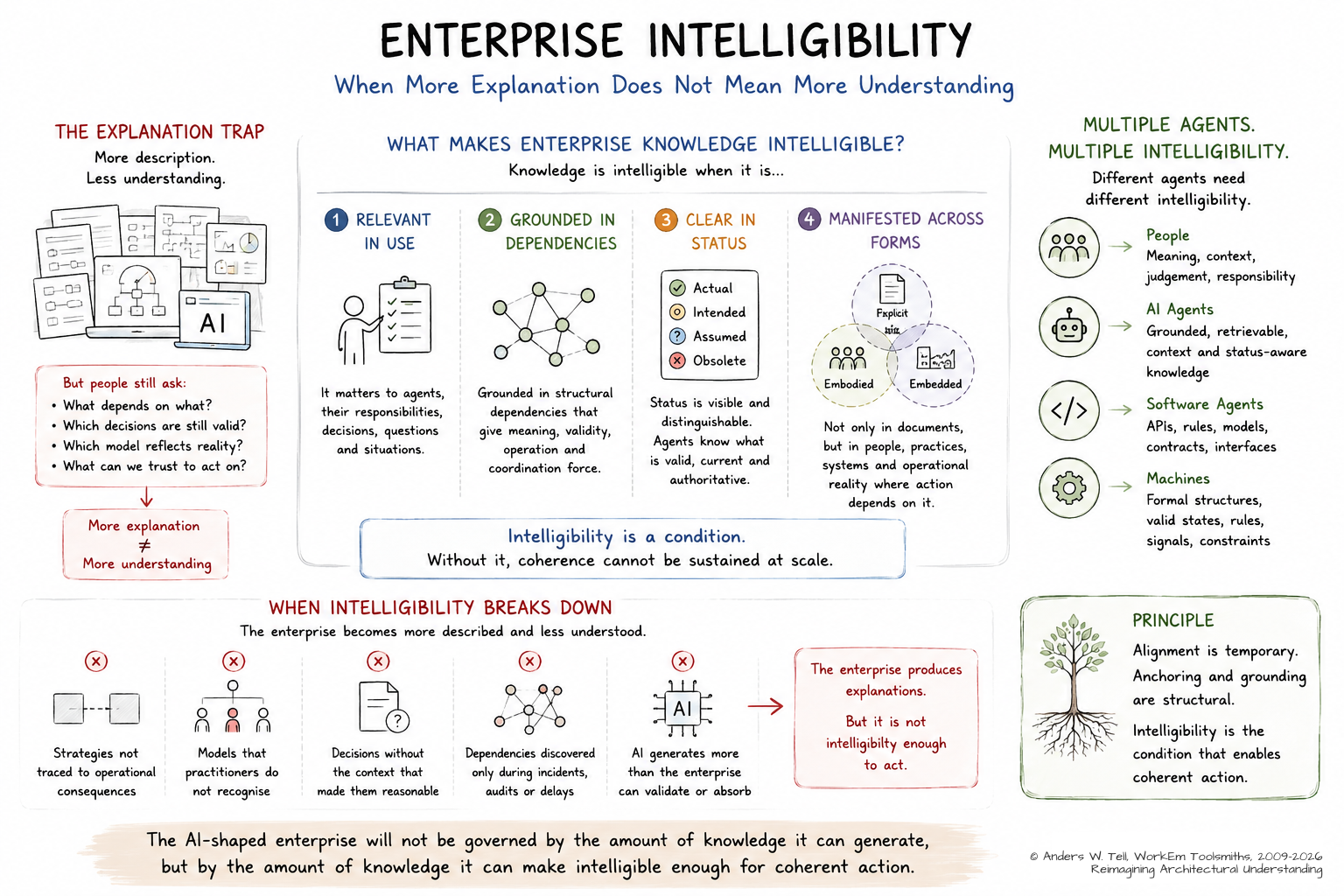
AI can explain the enterprise without making it intelligible.
1. The Enterprise Becomes More Described and Less Understood
The modern enterprise is not short of explanations.
It has strategies, operating models, roadmaps, architecture models, dashboards, process diagrams, policies, decision records, transformation narratives, and increasingly AI-generated summaries of all of them.
Yet people still struggle to answer basic questions.
What actually matters?
What depends on what?
Which decisions are still valid?
Which model reflects reality?
Which system, process, team, policy, or obligation is affected if this changes?
What can be trusted enough to act on?
The enterprise becomes more described and less understood.
That is the problem of Enterprise Intelligibility.
More explanation does not mean more understanding.
More representation does not mean more intelligibility.
More generated knowledge does not mean more coherent action.
- Details
- Category: Reimagine Architecture
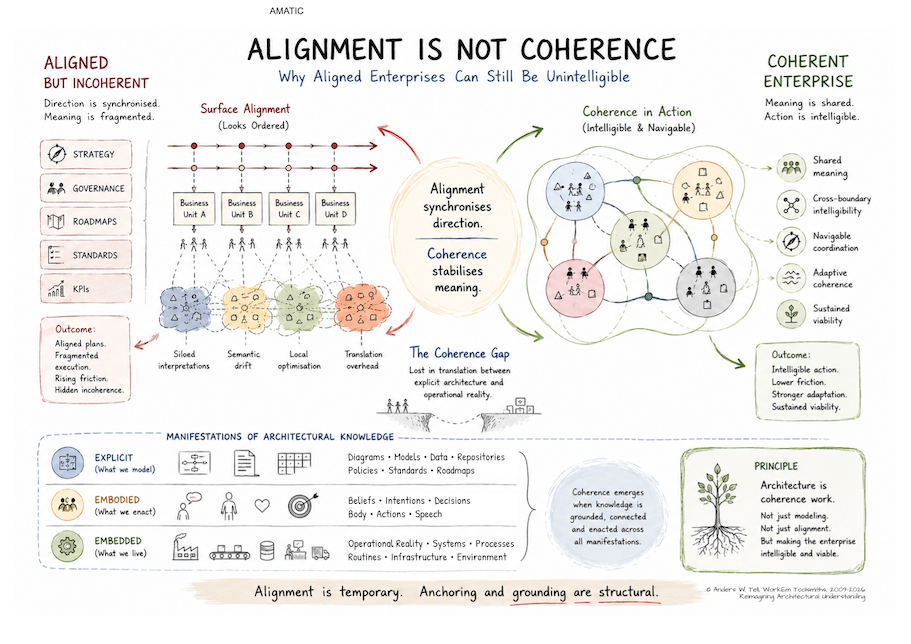
Enterprise Architecture has spent two decades promising alignment.
But many organisations are already living the result. They are meticulously aligned and still operationally incoherent. The missing distinction is between alignment and coherence.
- Details
- Category: Standalone
What a systematic literature review reveals about how EA is assessed — and what is missing
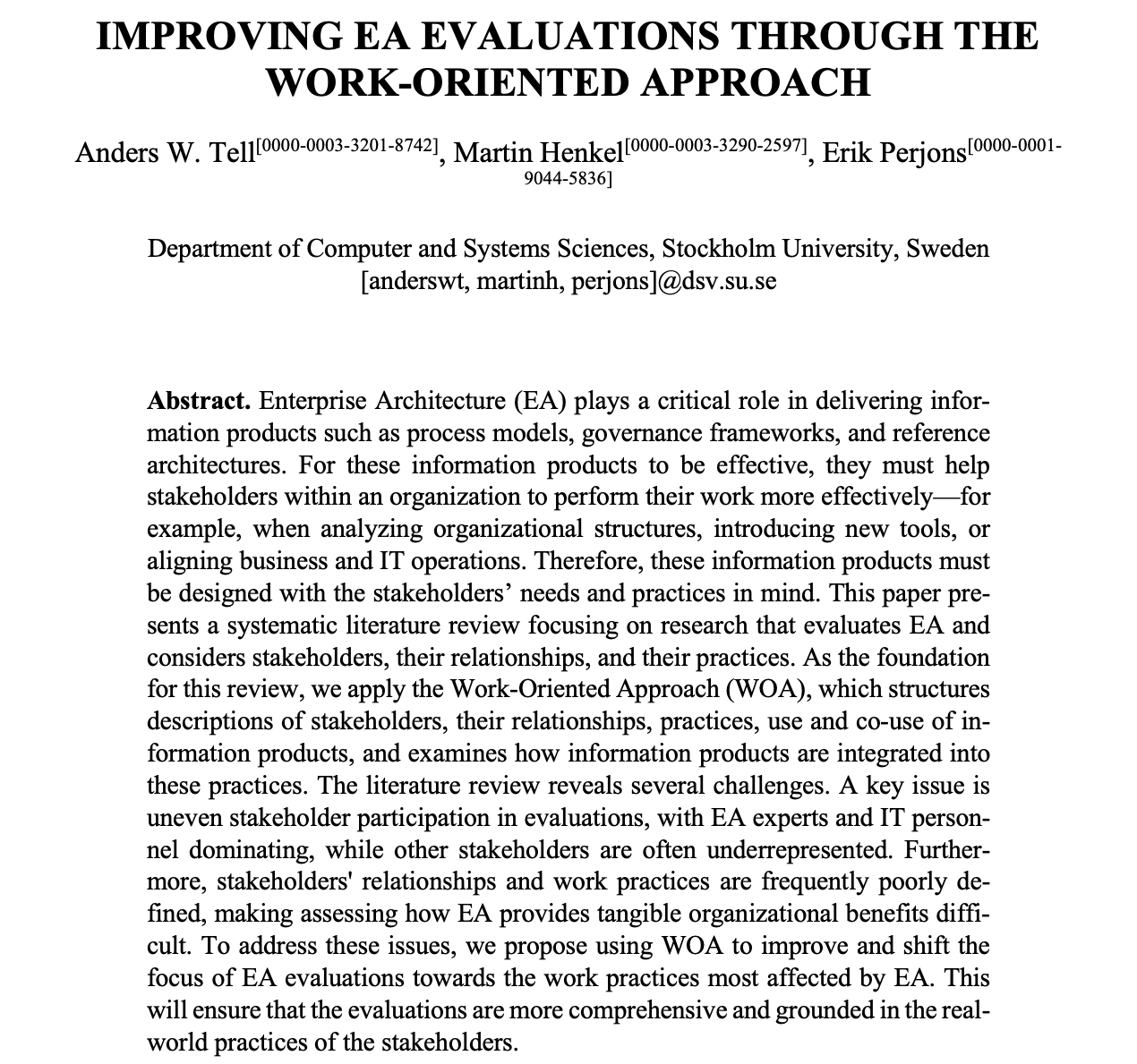
A peer-reviewed paper co-authored with Martin Henkel and Erik Perjons of Stockholm University — "Improving EA Evaluations Through the Work-Oriented Approach" — has been published in Springer Nature's Communications in Computer and Information Science (CCIS) series.
The central finding is blunt: enterprise architecture research predominantly evaluates EA through the eyes of those who produce it. The stakeholders whose work EA is supposed to improve are largely absent from the evaluations that claim to assess whether it does.
Contact:
WorkEm Toolsmiths
info AT workem.com
+46 768 790730
+49 152 2241 0640
Locations:
Munich
Milano