WorkEm Blog

We blog to share our story about Working Together, Interweaving, and Modern Work-oriented Architecting. By sharing we can inform and encourage discussions and collaborations on the Interweaved world, we all belong to.

Participation Creates Coherence

Participation-Creates-Coherence-illustration-ln

Integration connects. Participation holds. The order moves. The supplier is notified. The machine produces an event. The document is available. The rule is enforced. The obligation is recorded. The customer situation is visible. The manager sees status. And still, the enterprise action may not hold together.That is the difficulty this article addre...

Continue reading

Connection Is Not Coherence

Why-Integration-Does-Not-Create-Coherence-illustration

Many enterprises are more integrated than ever.Orders move from sales to production. Deliveries are visible to logistics. Invoices are triggered. Customer records are shared. Policies can be retrieved. Dashboards update. Systems exchange information. Work crosses boundaries faster than before.And still, the enterprise action does not hold together....

Continue reading

What Makes Enterprises Intelligible?

What-Makes-Enterprises-Intelligible-illustration

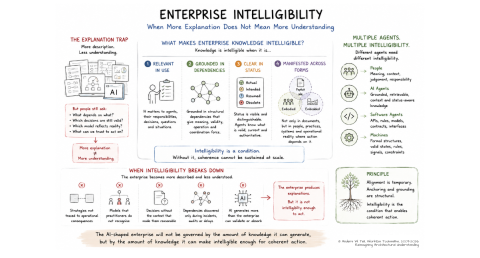
Many enterprises suffer from a paradox.As they grow, they produce more strategies, policies, principles, repositories, dashboards, models, standards, reports, and documentation. Yet despite this increasing volume of information, they often become harder to understand.More explanation does not necessarily lead to greater understanding.The question, ...
Continue reading

Enterprise Intelligibility: When More Explanation Does Not Mean More Understanding

The-Enterprise-Is-Becoming-Unintelligible-illustration-ln

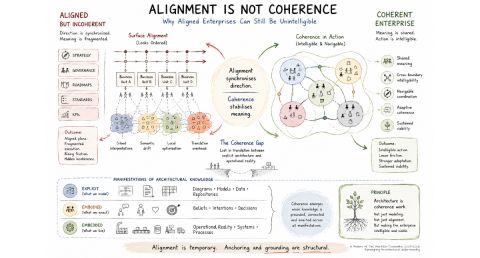
The modern enterprise is not short of explanations.It has strategies, roadmaps, architecture models, dashboards, policies, decision records, operating models, transformation narratives, and increasingly AI-generated summaries of all of them.Yet people still struggle to answer basic questions.What actually matters? What depends on what? Which decisi...

Continue reading

Why Enterprise Architecture's Obsession with Alignment Is No Longer Enough

Alignment_Is_Not_Coherence_Illustration_Final--LinkedIn

For years, Enterprise Architecture has treated alignment as the organisational ideal. Business alignment. IT alignment. Strategic alignment. Capability alignment. Operating model alignment. But many enterprises are already experiencing something uncomfortable:They are highly aligned and still operationally fragmented.They have: governance,synchroni...

Continue reading

The Argument Is Not About the Work

evolutionary-attitudes-illustration

Three people leave the same strategy review. One believes the plan is feasible. One thinks it needs major revision. One is certain it will be ignored.None of them is looking at different evidence. They are holding different attitudes toward the same object.Most friction in strategy, design, and architecture work follows this pattern. A developer sa...

Continue reading

"We Cannot Do This" Means Three Different Things

Modalities-illustration

A developer says "we cannot do this."A director says "this is required."An architect says "this is permitted."Each statement sounds like a fact about the work. Each is actually a statement about the kind of constraint in play. And each kind requires an entirely different response.When a developer says "we cannot do this" and means it is technically...

Continue reading

EA Evaluates Itself

article-screenshot-wider

What a systematic literature review reveals about how EA is assessed — and what is missing A peer-reviewed paper co-authored with Martin Henkel and Erik Perjons of Stockholm University — "Improving EA Evaluations Through the Work-Oriented Approach" — has been published in Springer Nature's Communications in Computer and Informatio...

Continue reading

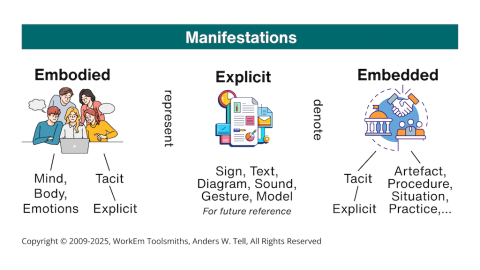
Beyond Blueprints - Manifestations: Three Manifestations of Strategy, Design, Architecture, and Interweave

Beyond Blueprints - Manifestations: Three Manifestations of Strategy, Design, Architecture, and Interweave

When we think of strategy, architecture, or design, we often picture tangible outputs: the detailed strategic plan in a binder, the architectural blueprint, or the final design model. However, these documents represent only a fraction of the total knowledge. The real substance of any strategic or design initiative exists in multiple forms, often un...

Continue reading

Designing For The Future: Mutability And Changeability (1)

One of the design qualities that design projects should consider is what changes in a solution, artefact or service are anticipated. Or, how should they evolve over time?This quality is often called the mutability or changeability of a solution. Both concern the inherent capacity of a design to be changed, adapted to changes, extended, modified and...

Continue reading

Work-Oriented Approach (to Information Products) (WOA)

The Work-Oriented Approach (to Information Products) (WOA) is a research-based method that addresses information production and consumption.The focus is on individuals' use and organisations' co-use of information such as reports, studies and models to increase organisations' aggregate utility and improve stakeholder values and economic, social and...

Continue reading

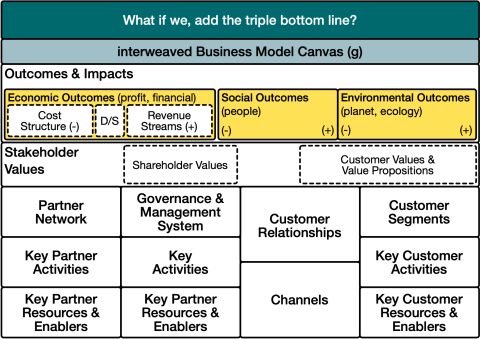
Step g) What if we, add triple bottom line?

In this transformation, we introduce the concept of Triple Bottom Line into the iBMC. The central idea behind the Triple Bottom Line is that organisations should evaluate their performance from a broader perspective, including their social and environmental impacts, in addition to their economic performance—rather than focusing on generating profit...

Continue reading

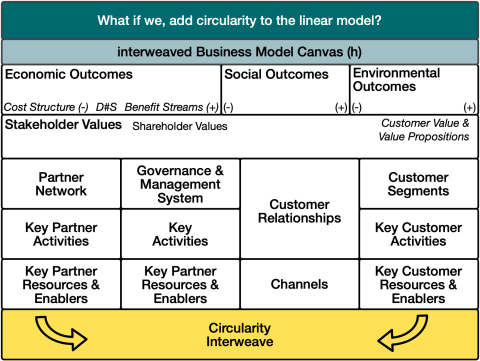
Step h) What if we, add circularity to the linear model?

In this transformation, we introduce the concept of Circular Economy into the up until now the linear iBMC. More to come soon. . The full article is found here:

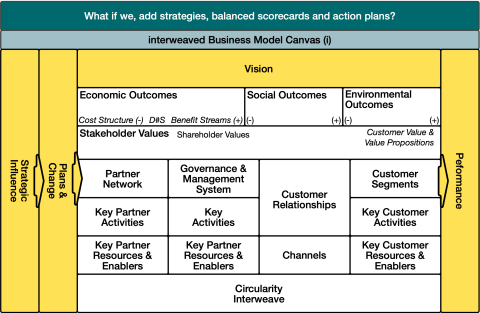
Step i) What if we, add strategies, balanced scorecards and action plans?

In this transformation, we introduce the concept of Strategy to the  iBMC. More to come soon. . The full article is found here:

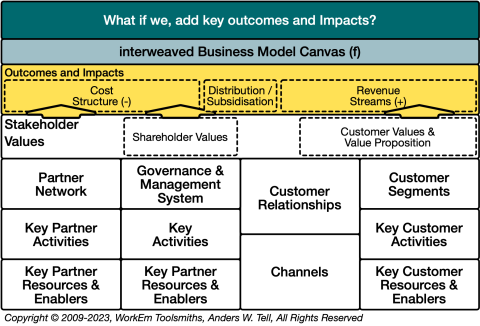
Step f) What if we, add key impacts and outcomes?

In this transformation, we generalise the concepts of "Cost Structure" and "Revenue Streams" into an "Outcomes and Impacts" theme and introduce the concepts of "Distribution" and "Subsidisation". Enabling: This opens up discussions about different kinds of positive (+) and negative (-) outcomes and impacts that are considered relevant and that stak...

Continue reading

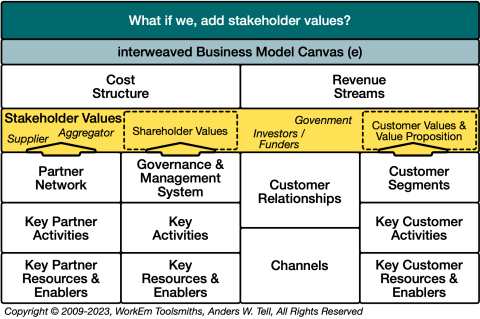
Step e) What if we, add stakeholder values?

In this transformation, we generalise the concept of "Value Proposition" into "Stakeholder Values" that are moved up the Value Ladder into a position above the organisation, partners and customer. Enable: This opens up discussions about values and benefits for more stakeholders than the customers. Interweave: The broadening of "Value Propositions" ...

Continue reading

Reimagining The Business Model Canvas for Triple-Bottom-Line

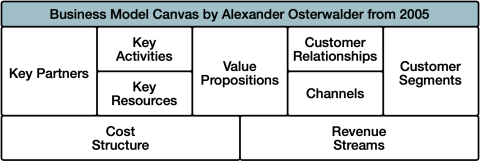
The popular Business Model Canvas (BMC) from 2005 by Alexander Osterwalder et al. offers a basic tool for discussing business models. It is often used in workshops where it provides simplicity for people who do not typically develop business models. The simplicity comes with a price; it is easy to fall off the canvas when discussing deeper aspects ...

Continue reading

The Starting Point - Reimagining The Business Model Canvas -

0. The starting point: Business Model Canvas The starting point and baseline is the well-known Business Model Canvas (BMC) from 2005 by Alexander Osterwalder, as illustrated in the book "Business Model Generation" from 2010. he canvas contains 9 parts that are translated into 9 themes and talking points using the Bricks and Mortars practice. We lea...

Continue reading

Step a) of Reimagining The Business Model Canvas for Triple-Bottom-Line

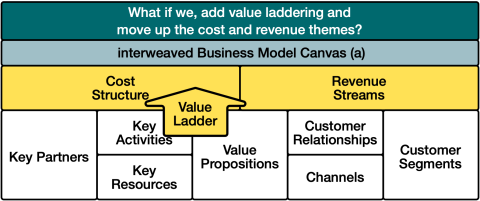
a. What if we, add value laddering and move up the cost and revenue themes? In this first transformation, we make a seemingly trivial change by moving the cost structure and revenue streams up to the top of the canvas. This graphical change introduces something that later will be proven to be important: value-laddering. A value ladder links differe...

Continue reading

Step b) of Reimagining The Business Model Canvas for Triple-Bottom-Line

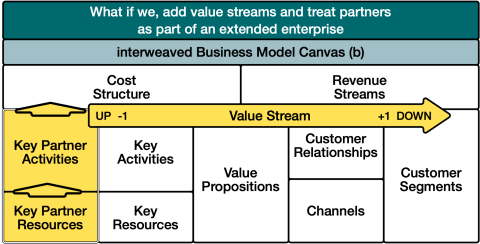
b. What if we, add value streams and treat partners as part of an extended enterprise? In this transformation, we first add or rather make visible the underlying value stream or the end-to-end collection of activities that create a result for or satisfy the customers. A value chain links together up-stream partner activities with a company's activi...

Continue reading

By accepting you will be accessing a service provided by a third-party external to http://workem.com/

Contact:
WorkEm Toolsmiths
info AT workem.com
+46 768 790730
+49 152 2241 0640

Locations:
Munich
Milano