2. Alignment May Point. Coherence Must Hold. Intelligibility Enables Agents to Act.
In a previous article, I argued that alignment is not coherence. Alignment may point activities in a compatible direction, but it does not guarantee that the enterprise holds together in practice.
Enterprise Intelligibility adds another distinction.
Alignment asks whether things point in a compatible direction.
Coherence asks whether things hold together meaningfully and functionally enough to support action.
Intelligibility asks whether relevant agents can understand, navigate, explain, and act within that enterprise reality.
Coherence is the condition where enterprise parts hold together meaningfully enough to support action. Intelligibility is the condition where relevant agents can understand, navigate, and act within that coherence. Coherence cannot be sustained at scale when agents cannot make sense of what they are part of.
An organisation can appear aligned in strategy documents while remaining incoherent in practice. It can also contain pockets of coherence that are not intelligible enough for others to understand, trust, extend, or act within.
That is why Enterprise Intelligibility matters.
It is not enough that architecture exists.
It is not enough that strategy is documented.
It is not enough that systems are mapped.
It is not enough that AI can summarise the material.
The question is whether the enterprise can be understood well enough for coherent action across boundaries.
3. What Enterprise Intelligibility Means
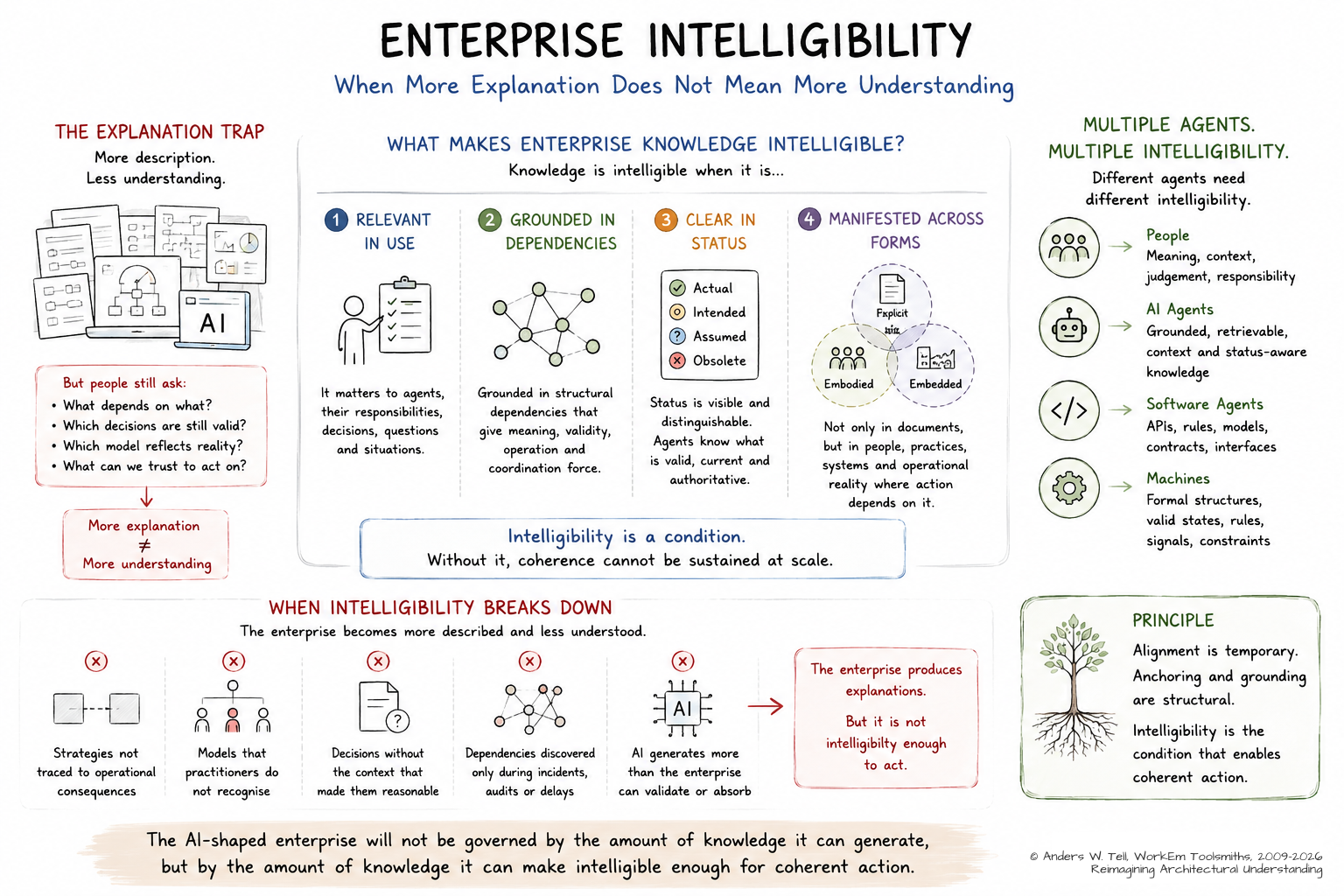
Enterprise Intelligibility is the condition in which relevant agents can understand and act across the enterprise because knowledge is relevant in use, grounded in dependencies, clear in status, and manifested across explicit, embodied, and embedded forms.
This definition matters because it moves intelligibility beyond readability, documentation, and visualisation.
Relevance in use means that enterprise knowledge matters to the agents, practices, responsibilities, decisions, and questions in which it will be used.
Grounded in dependencies means grounded in the structural dependencies that give enterprise knowledge meaning, validity, operation, and coordination force.
Clear in status means that agents can distinguish actual from intended, assumed from evidenced, current from obsolete, authoritative from provisional, and human-created from AI-generated.
Manifested across forms means that knowledge does not exist only as representation. It must also be carried in people, practices, systems, routines, controls, and operational reality, where action depends on it.
Enterprise knowledge is not intelligible merely because it is written down. It is not intelligible merely because it is placed in a repository. It is not intelligible merely because it can be rendered as a diagram, dashboard, or AI-generated explanation.
Knowledge becomes enterprise-intelligible only when it can be used by the agents who need it, in the situations where understanding, judgement, coordination, and action are required.
Those agents are no longer only human.
Enterprise knowledge must be made intelligible to the agents who must use it: executives, architects, practitioners, regulators, AI agents, software agents, and machines, without pretending that the same representation works for all of them.
For people, intelligibility depends on meaning, context, judgment, and responsibility. For AI agents, it depends on grounded, retrievable, context, and status-aware knowledge. For machines, it depends on formalised structures, valid states, rules, interfaces, and signals.
This is a decisive shift.
The enterprise must increasingly support multiple forms of intelligibility simultaneously. A board decision, an architecture principle, a regulatory obligation, routine, a data definition, an API contract, a workflow rule, and an AI-generated recommendation may all refer to the same enterprise reality. But they do not make that reality intelligible in the same way.
The same representation does not work for every agent.
4. Why Enterprises Become Unintelligible
Enterprises become unintelligible when meanings, dependencies, decisions, practices, systems, obligations, and operational reality drift apart.
This is not simply a documentation problem.
Documentation may exist. Models may exist. Governance may exist. Reports may exist. AI summaries may exist. The problem is that enterprise knowledge no longer supports situated understanding and action.
Strategies cannot be traced to operational consequences. Architecture models exist, but practitioners do not recognise their work in them. Decisions are recorded without the context that made them reasonable. Dependencies are discovered only during incidents, audits, or transformation delays. AI produces more enterprise artefacts than the organisation can validate, absorb, or manifest in work.
The enterprise becomes increasingly explicit without becoming more intelligible.
This is one of the central failures of representation-heavy architecture.
A model may be correct enough to satisfy a method.
A diagram may be clear enough to present.
A roadmap may be plausible enough to approve.
A strategy may be polished enough to publish.
An AI summary may be fluent enough to circulate.
But if the knowledge is not relevant in use, grounded in dependencies, clear in status, and manifested across forms, it is not yet enterprise-intelligible.
Grounding here means structural dependency, not shared understanding or stakeholder agreement.
An ungrounded concept can still be repeated.
An ungrounded model can still be approved.
An ungrounded AI explanation can still sound convincing.
But it does not give agents a reliable basis for action.
5. Intelligibility Is Not Abstract Transparency
It is tempting to frame this as a transparency problem.
That is too weak.
Intelligibility is not abstract transparency. It is the ability to make sense of the enterprise from within the practices, systems, responsibilities, rules, routines, and material arrangements where work actually happens.
People do not understand the enterprise from nowhere. They understand from situated positions: as executives, architects, product owners, process owners, engineers, auditors, service designers, regulators, operators, partners, and users. Each position brings different responsibilities, questions, constraints, and opportunities for action.
A regulator needs evidence, obligation, traceability, and assurance.
An architect needs dependencies, constraints, patterns, options, and trade-offs.
A practitioner needs relevance to work, responsibility, and local decision-making.
An executive needs consequence, confidence, and strategic judgement.
An AI agent needs grounded, retrievable, and status-aware knowledge.
A machine needs formal structures, valid states, rules, signals, and interfaces.
This is multiple intelligibility.
Enterprise knowledge must make sense across different agents and practices without pretending that one view, one model, one dashboard, or one language can serve them all.
Traditional Enterprise Architecture has long recognised part of this through stakeholders, concerns, viewpoints, and views. That remains useful. But Enterprise Intelligibility asks for more than understandable views. It asks whether enterprise knowledge can be understood and acted upon in the situations where enterprise action actually happens.
6. AI Can Explain the Enterprise Without Making It Intelligible
AI changes the intelligibility equation.
It accelerates the production and circulation of enterprise representations: strategies, summaries, models, decisions, requirements, policies, diagrams, analyses, and recommendations.
But more representation is not the same as more understanding.
AI may clarify what was previously scattered. It may help people compare alternatives, expose gaps, summarise complexity, and connect knowledge across boundaries. Used well, it can become an intelligibility aid.
But AI can also become an intelligibility stressor. It can produce fluent explanations that lack practical grounding. It can generate plausible models that are not grounded in real dependencies. It can amplify assumptions, obscure knowledge status, and make fragmented enterprise knowledge appear coherent before the organisation has validated, absorbed, or manifested it in work.
AI can explain the enterprise without making it intelligible.
7. The Question Architecture Must Now Face
That is why Enterprise Intelligibility becomes more important in the AI-shaped enterprise, not less.
The central question is no longer only whether an organisation can produce more knowledge artefacts. It is whether those artefacts are relevant, grounded, status-aware, manifested, and usable in the situations where people, AI agents, software agents, and machines must coordinate action.
The enterprise may continue to produce explanations. It may continue to refine its models. It may continue to integrate systems, standardise terminology, automate decisions, and generate new layers of analysis.
Yet the basic question may remain unanswered:
Can the relevant agents understand what they are part of well enough to act coherently across boundaries?
That question cannot be answered by producing more artefacts.
It cannot be answered by alignment alone.
It cannot be answered by AI fluency.
It requires asking what makes enterprise knowledge intelligible in the first place.
AI does not remove the need for architecture. It increases the cost of weak architecture.
AI does not remove the need for enterprise understanding. It increases the cost of unintelligibility.
The AI-shaped enterprise will not be governed by the amount of knowledge it can generate, but by the amount of knowledge it can make intelligible enough for coherent action.
This is not a documentation challenge.
It is an architectural challenge.
The future enterprise does not need to be aligned only.
It needs to be coherent enough to hold.
It needs to be intelligible enough for relevant agents to act.
That includes people.
That includes AI agents.
That includes software agents.
That includes machines.
Enterprise Intelligibility is therefore not a soft concern. It is not a communication afterthought. It is not the decorative layer added after strategy, architecture, governance, and transformation have done their work.
It is a condition for their work to matter.
Alignment may point.
Coherence must hold.
Intelligibility enables agents to act.
But how does an enterprise become intelligible enough for that action?
That is the question the next article must answer.
/Anders W. Tell
Reimagining Architectural Understanding