

WorkEm Blog
Why Enterprise Architecture's Obsession with Alignment Is No Longer Enough
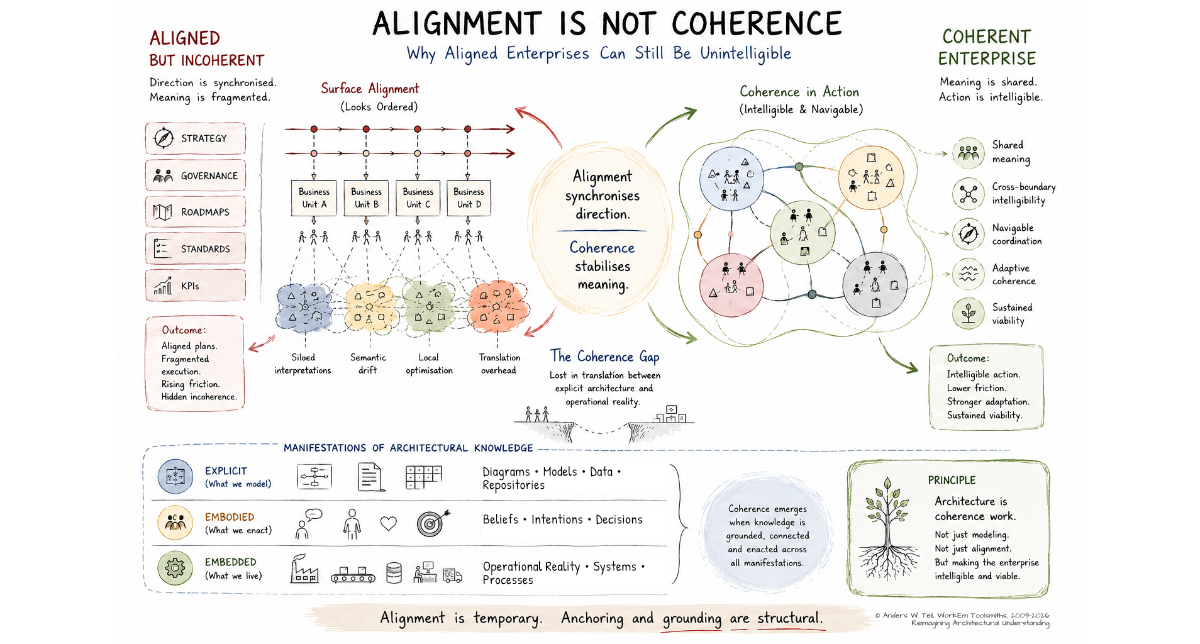
For years, Enterprise Architecture has treated alignment as the organisational ideal.
- Business alignment.
- IT alignment.
- Strategic alignment.
- Capability alignment.
- Operating model alignment.
But many enterprises are already experiencing something uncomfortable:
They are highly aligned and still operationally fragmented.
They have:
- governance,
- synchronised roadmaps,
- target architectures,
- transformation programs,
- and aligned KPIs,
Yet people still spend enormous amounts of time:
- translating between meanings,
- reconciling conflicting interpretations,
- rebuilding shared understanding,
- and coordinating across fractured boundaries.
The organisation is aligned.
But it is not coherent.
This distinction increasingly matters in AI-shaped enterprises, where local optimisation and distributed decision-making amplify fragmentation across systems, teams, models, and interpretations.
The new article explores a distinction that architecture rarely treats explicitly:
- Alignment is a relationship operator.
- Cohesion is a relational condition.
- Coherence is an emergent systemic condition.
The article also introduces manifestations as forms in which architectural knowledge exists:
- explicitly in artefacts and representations,
- embodied in agents and practices,
- and embedded in operational realities, routines, structures, and systems.
This matters because architecture often appears coherent in documents while becoming incoherent in practice.
The article argues that Enterprise Architecture has often been optimising alignment while implicitly assuming coherence would emerge automatically.
But aligned organisations can still become unintelligible.
And unintelligible enterprises eventually lose their ability to coordinate.
The article also connects coherence to:
- grounding,
- anchoring,
- intelligibility,
- enterprise cognition,
- manifestations,
- and Interweaving as a coherence-oriented architectural approach.
Alignment synchronises direction.
Coherence stabilises meaning.
Alignment is temporary.
Anchoring and grounding are structural.
New article: Alignment Is Not Coherence
/Anders W. Tell
Reimagining Architectural Understanding
When you subscribe to the blog, we will send you an e-mail when there are new updates on the site so you wouldn't miss them.
About the author

By accepting you will be accessing a service provided by a third-party external to http://workem.com/