The popular Business Model Canvas (BMC) from 2005 by Alexander Osterwalder et al. offers a basic tool for discussing business models. It is often used in workshops where it provides simplicity for people who do not typically develop business models. The simplicity comes with a price; it is easy to fall off the canvas when discussing deeper aspects ...
WorkEm Blog
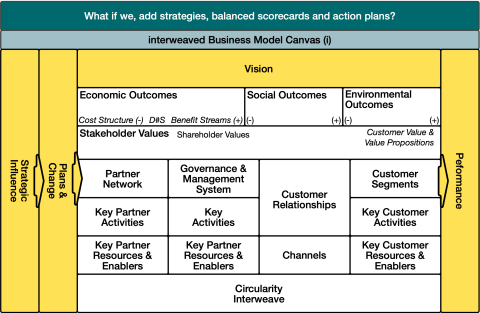
In this transformation, we introduce the concept of Strategy to the iBMC. More to come soon. . The full article is found here:
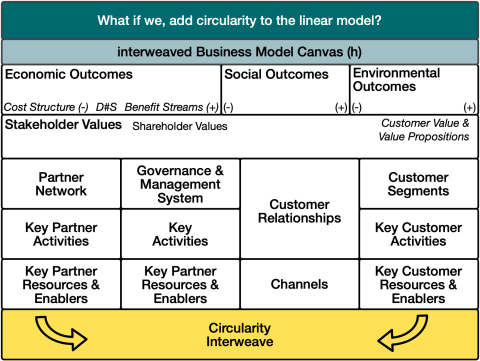
In this transformation, we introduce the concept of Circular Economy into the up until now the linear iBMC. More to come soon. . The full article is found here:
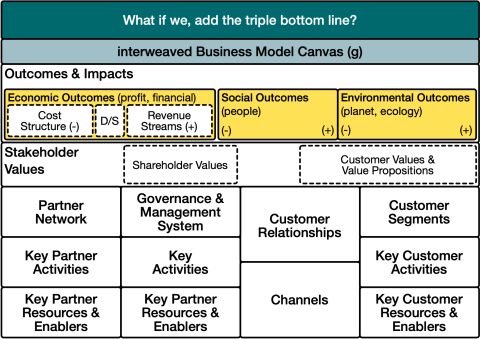
In this transformation, we introduce the concept of Triple Bottom Line into the iBMC. The central idea behind the Triple Bottom Line is that organisations should evaluate their performance from a broader perspective, including their social and environmental impacts, in addition to their economic performance—rather than focusing on generating profit...
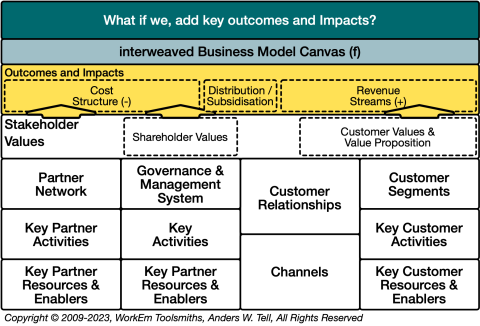
In this transformation, we generalise the concepts of "Cost Structure" and "Revenue Streams" into an "Outcomes and Impacts" theme and introduce the concepts of "Distribution" and "Subsidisation". Enabling: This opens up discussions about different kinds of positive (+) and negative (-) outcomes and impacts that are considered relevant and that stak...
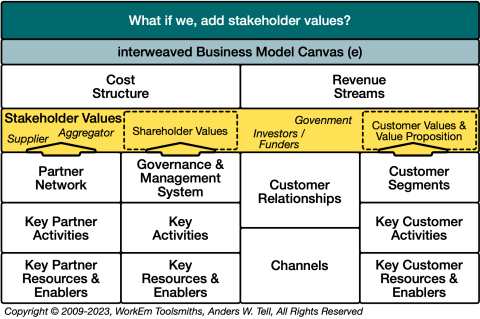
In this transformation, we generalise the concept of "Value Proposition" into "Stakeholder Values" that are moved up the Value Ladder into a position above the organisation, partners and customer. Enable: This opens up discussions about values and benefits for more stakeholders than the customers. Interweave: The broadening of "Value Propositions" ...
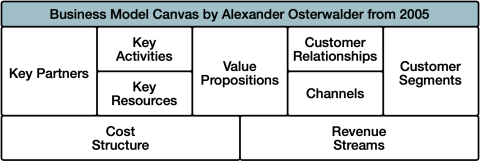
0. The starting point: Business Model Canvas The starting point and baseline is the well-known Business Model Canvas (BMC) from 2005 by Alexander Osterwalder, as illustrated in the book "Business Model Generation" from 2010. he canvas contains 9 parts that are translated into 9 themes and talking points using the Bricks and Mortars practice. We lea...
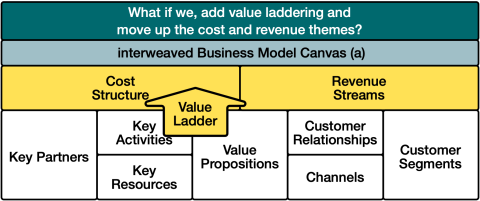
a. What if we, add value laddering and move up the cost and revenue themes? In this first transformation, we make a seemingly trivial change by moving the cost structure and revenue streams up to the top of the canvas. This graphical change introduces something that later will be proven to be important: value-laddering. A value ladder links differe...
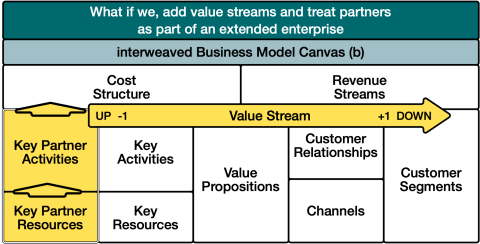
b. What if we, add value streams and treat partners as part of an extended enterprise? In this transformation, we first add or rather make visible the underlying value stream or the end-to-end collection of activities that create a result for or satisfy the customers. A value chain links together up-stream partner activities with a company's activi...
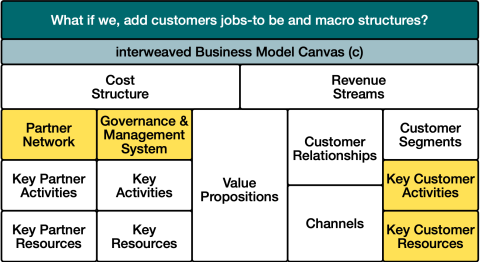
c. What if we, add customers jobs-to be and macro structures? In this transformation, we balance the interweaved Business Model Canvas in two ways. Firstly, we add "Key Customer Activities" and "Key Customer Resources" themes in addition to "Customer Segment(s)" to match the organisation's and partner's activities and resources.Secondly, we add a "...
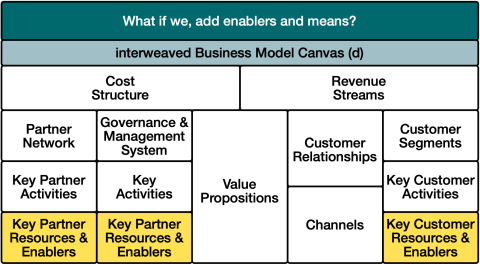
d. What if we add enablers and means? In this Transformation, we add the concept of "Enabler" to the "Key Resources" theme. Enable: This opens up discussions about key elements that are means, help, support, facilitate or enable the organisation in focus to create and sustain value. This is in addition to having access to or own and use resou...
The popular Business Model Canvas (BMC) from 2005 by Alexander Osterwalder et al. offers a basic tool for discussing business models. It is often used in workshops where it provides simplicity for people who do not typically develop business models. The simplicity comes with a price; it is easy to fall off the canvas when discussing aspects related...
By accepting you will be accessing a service provided by a third-party external to http://workem.com/